1 DOLLAR SALE - Shop my products for only $1 - Each product automatically discounted to $1 or the equivalent of your local currency at checkout! (Please note that taxes and payment processing fees may be added at checkout). If the code is not applied at checkout, please use code 1DOLLARSALE. SHOP HERE
Turn Simple Creative Projects Into Multiple Online Income Streams With Free And Affordable Resources
This site includes links from a number of different affiliate programs. When you click on a link and make a purchase, we may earn a commission.
How to Create Digital Products with Public Domain Resources (Including Christian Printables and Devotionals)
If you want to save time and energy when creating digital products, using public domain resources is one of the smartest ways to do it. Instead of starting from scratch, you can build on content that already exists and turn it into something new and valuable.
This approach has been around for a long time, but a lot of people overlook it.
It’s called the public domain.
What Is the Public Domain, Exactly?
When a creative work’s copyright expires or when it was never copyrighted to begin with, it enters the public domain. That means anyone can use it, adapt it, publish it, or build on it. No permission required. No licensing fees.
In the United States, works published before 1928 are generally in the public domain. That’s an enormous library of literature, art, poetry, music, essays, scientific writing, and more - all freely available to anyone with an internet connection and a little know-how.
The key word is freely. Not free as in worthless. Free as in no gatekeepers.
General Digital Products You Can Build With Public Domain Material
The public domain is a legitimate content goldmine for digital product creators. Here’s what that looks like in practice.
Books and ebooks. Take a classic text, add your own introduction, annotations, or study questions, and publish it under your own brand. You are not plagiarizing - you are curating. That’s a real skill people will pay for. You can also create new types of books using public domain resources, e. g. turning Jane Austen's works into journals.
Printables and workbooks. Pull quotes, poems, or passages from public domain works and turn them into journaling pages, quote cards, or reflection prompts. Pair the text with your own design and you have a product that didn’t exist before.
Coloring pages. Vintage illustrations from old books, botanical drawings, ornamental borders - thousands of these exist in the public domain. Run them through a vectorizer or adapt them in Canva, and you have ready-made coloring content.
Planners and trackers. Use public domain essays or aphorisms as section headers or motivational content within a planner. The text adds depth without adding cost.
Courses and guides. Classic works on philosophy, personal development, rhetoric, agriculture, cooking - almost any topic imaginable - can form the backbone of a teaching resource. Your job is to translate the insight into modern language and practical application.
Social media content. Vintage advertisements, illustrations, and literary quotes all make strong visual content. The aesthetic is distinctive. It stands out.
The real value isn’t just in the material itself. It’s in knowing what to do with it. Curation, design, and context are the products. The public domain gives you the raw material.
Why This Works Especially Well for Christian Digital Products
The Christian creator has an unusual advantage here.
Certain Bible translations, classic hymnals, and the writings of the early church fathers, the Puritans, the Reformers, and the Victorian-era missionaries are in the public domain - all freely available and largely untapped for digital product purposes.
Think about what that means practically. A devotional built around Spurgeon’s Morning and Evening is legally usable. A prayer journal that incorporates Wesley’s prayers costs nothing to source. A study guide built around Bunyan’s Pilgrim’s Progress doesn’t require a publishing deal.
Which Bible Translations Are Actually in the Public Domain?
This is important to get right. Not all Bible translations are in the public domain and using a copyrighted translation in a product without a license is infringement. Here are the translations you can use freely in the US:
• King James Version (KJV) - 1611 original and subsequent pre-1928 editions. Public domain in the US. Note: it retains Crown Copyright in the UK.
• American Standard Version (ASV) - 1901. Fully public domain.
• Young’s Literal Translation (YLT) - Robert Young, 1862/1898. Public domain.
• Darby Bible Translation (DBT) - John Nelson Darby, 1890. Public domain.
• Webster’s Bible Translation - Noah Webster, 1833. Public domain.
• Douay-Rheims Bible - 1609–1610. Public domain.
• Geneva Bible - 1560. Public domain.
• Weymouth New Testament - 1903. Public domain.
• World English Bible (WEB) - A modern translation deliberately released into the public domain. No copyright restrictions at all. Particularly useful for contemporary digital products.
Translations that are not public domain include the NIV, ESV, NASB, NLT, CSB, NKJV, and The Message. These are all copyrighted. Don’t use them in products without a proper license.
Christian Digital Products You Can Build Right Now
Christian digital products built from public domain content can include:
Scripture cards and verse art using the KJV, ASV, WEB, or any of the other public domain translations listed above.
Devotional guides drawing on commentary or sermon excerpts from Spurgeon, Matthew Henry, Andrew Murray, or other classic writers.
Prayer cards and liturgical resources built from historic church prayers.
Coloring pages that pair public domain line art with Bible verses from public domain translations.
Study tools built around classic theological texts like Calvin’s Institutes or Bunyan’s works.
Journal and reflection pages that weave vintage spiritual wisdom with modern prompts.
The combination of timeless content and practical modern format is genuinely useful. That’s what good digital products do - they close the gap between resource and need.
There is also a stewardship angle worth naming. Ministry resources shouldn’t always cost a lot to produce. When the raw material is free, the price point for the end user can stay low. Accessibility matters.
Ready to Start Without Building Everything From Scratch?
If this is resonating with you, there’s a shortcut worth knowing about.
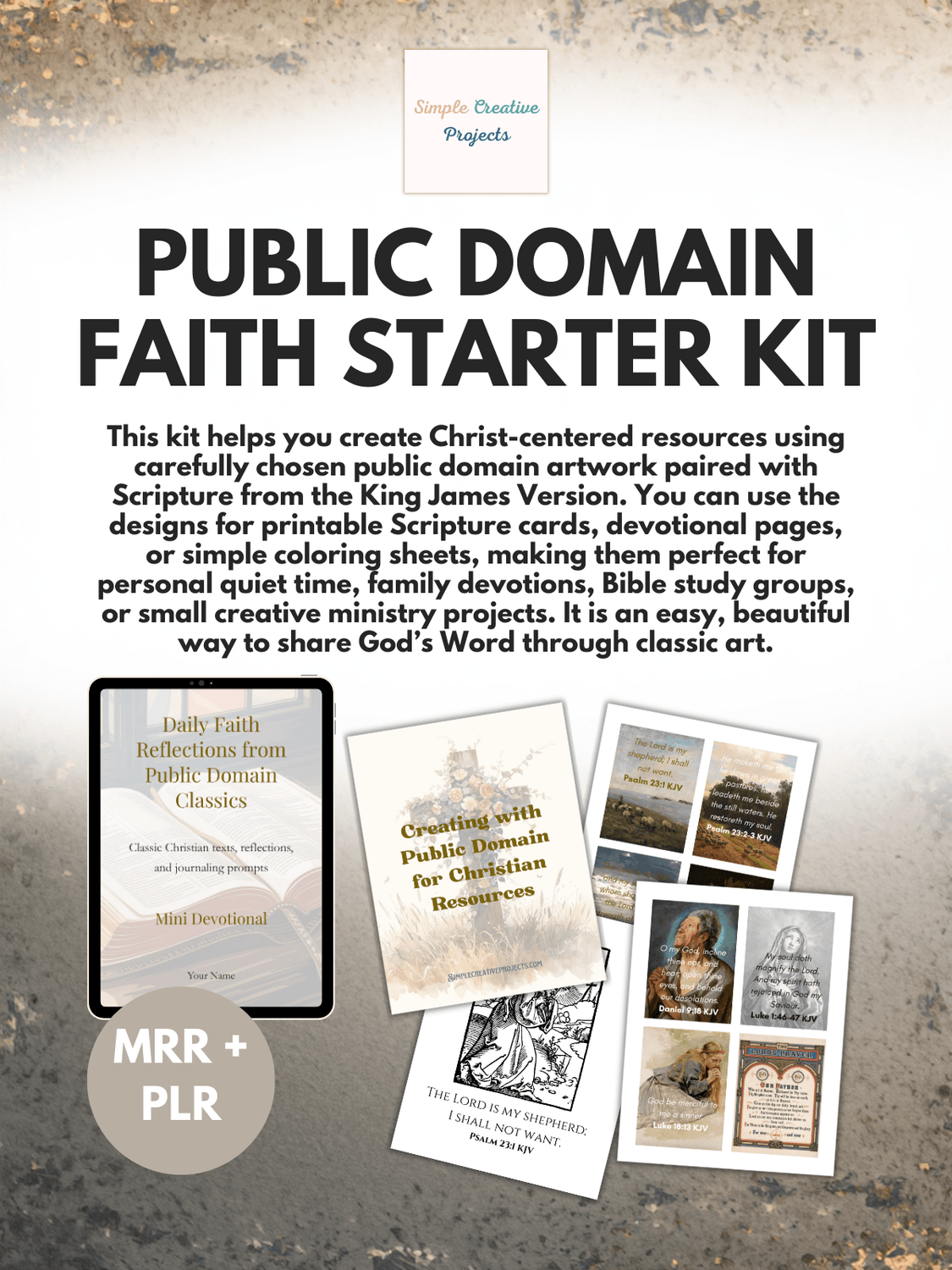
The Public Domain Faith Starter Kit at Simple Creative Projects is a done-for-you bundle of Christian creative resources, all built from public domain material and Scripture. It includes two guides - one on creating with public domain content for Christian resources, and one featuring daily reflections from public domain classics - delivered in Canva, PowerPoint, and PDF formats.
It also includes Psalms Scripture Cards, Prayers from Scripture Cards, and a set of Public Domain Scripture Coloring Pages that pair line art with Bible verses - all in editable and print-ready formats.
Every resource in the kit can be used for personal devotional use, ministry handouts, church groups, or digital product creation. And it comes with full Master Resell Rights and Private Label Rights, which means you can rebrand, modify, and resell everything as your own finished products, keeping 100% of the profits.
Right now it’s $7.
For someone who wants to understand how public domain resources work in a Christian context - and who wants a practical starting point with real, usable content - this kit removes the biggest barrier, which is figuring out where to begin.
The public domain has been sitting there waiting. Centuries of wisdom, art, Scripture, and story - freely available to anyone willing to do something thoughtful with it. For Christian creators especially, it’s not just a content strategy. It’s access to a legacy worth passing on.
Start with what’s already there. Build something worth keeping.
Thank you for reading this post. Please share it.
To stay inspired and get even more helpful tips and resources, make sure to:
Explore More – Check out the blog, digital products, and top affiliate recommendations to help you on your creative journey.
About Simple Creative Projects
Simple Creative Projects helps you turn simple creative projects into multiple online income streams using creative digital products, self-publishing low/medium-content books, and Affiliate Marketing in the creative niche. The focus is on practical steps, free and affordable resources, and building multiple income streams without overwhelm or complicated systems.
Free Gifts For Your Online Business
Find a collection of free and paid resources for Affiliate Marketing, Digital Products, and Self-Publishing here:
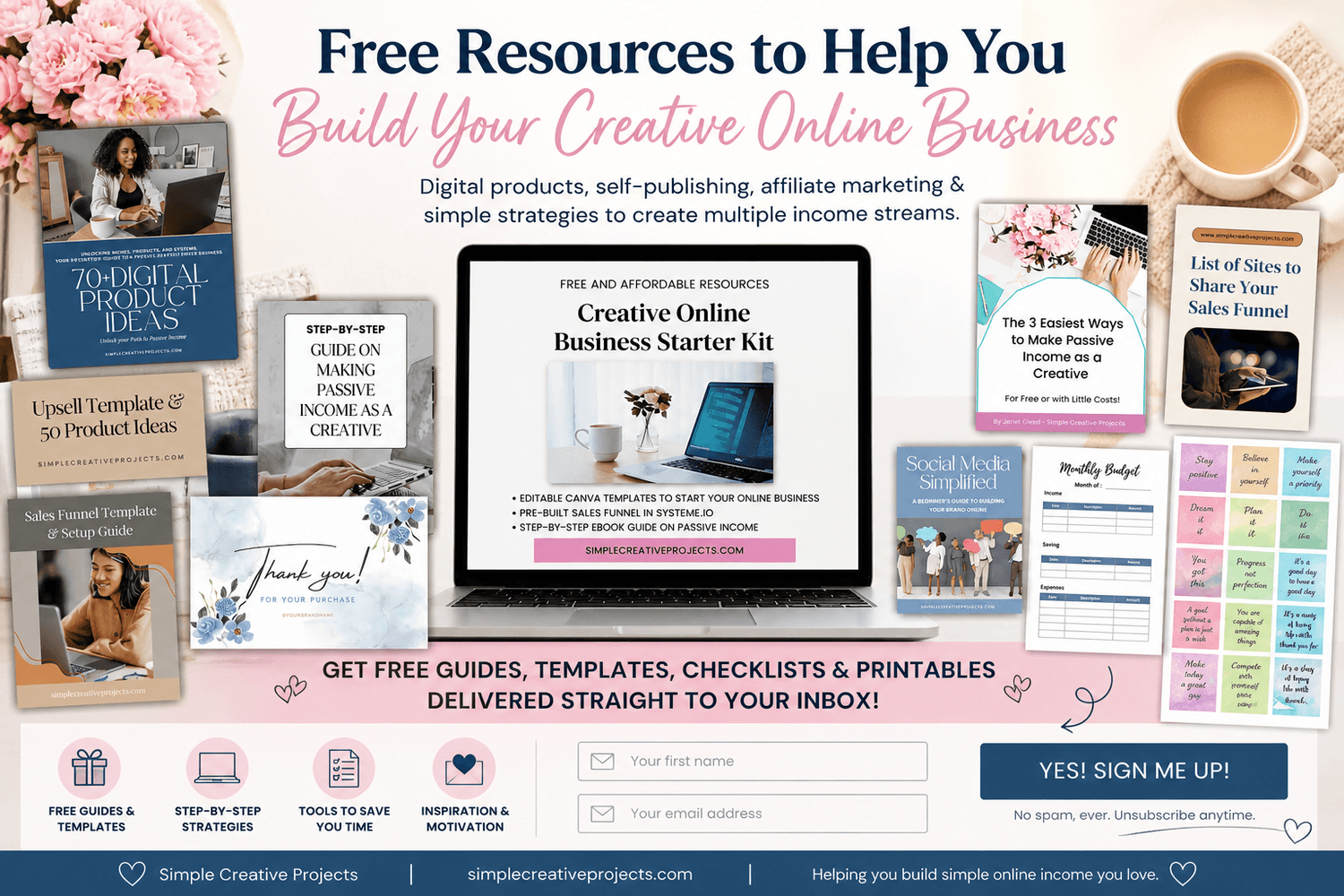
Get Free Digital Product Resources when you sign up for my newsletter!
Get my BEST updates delivered to your inbox. Join my email list and get my favorite content regularly. Unsubscribe anytime.

Hello, I'm Janet.
I’m a disciple and servant of Jesus Christ, helping people with limited resources and challenging circumstances turn simple creative projects into multiple online income streams through creative digital products, self-publishing low/medium-content books, and Affiliate Marketing in the creative niche. I’m also a wife, mom, teacher, author, Christian Life Coach, and creative entrepreneur.